Blocked Practice & Varied Practice, Part 2
Devon Boorman ·

There are two primary practice schema that can be applied when acquiring new skills: Blocked Practice and Varied Practice. In Blocked Practice you learn skill A, then practice skill A over and over again in sequence, building and refining motor programs. However, it lacks the ability to retain new skills and apply them within a tactical environment.
This is where Varied Practice comes in. By asking your brain to recall a series of different techniques, you reinforce the recall process and thus improve your ability to retain those skills. This can be done in a number of ways.
Varied Practice in Series
This is essentially a more complex form of blocked practice. Learn skill A, then skill B, then practice A and B in an alternating series. Then add in skill C and practice A, B, and C as a series. This form of exercise is not tactical (meaning you’re not making choices based on specific stimulus) but it does aid in retention and is useful for environments where a simpler form of learning is needed, and to reduce tactical stress.
Tactical Variance
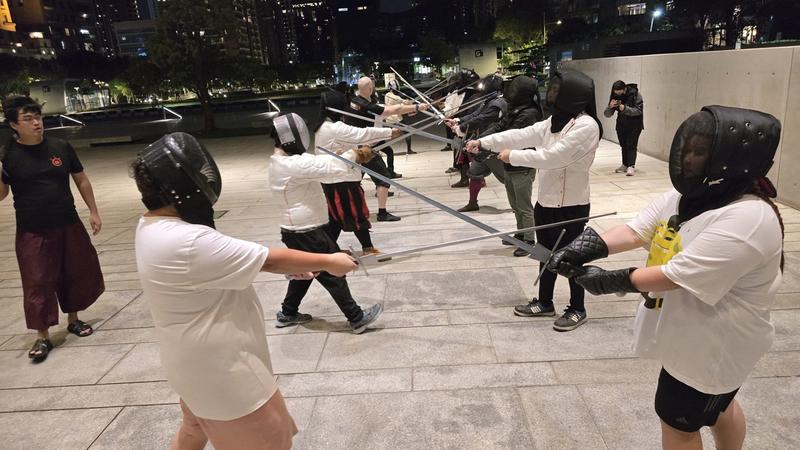
Here you learn a series of related skills within their tactical environment and then move between them based on stimulus. For example you learn to parry your right side, then your left, then you are queued in a random fashion with attacks to the right or left. This type of training is excellent because it does a better job of simulating the performance environment.
Where it can be challenging is that it adds a type of mental complexity that can make it difficult for some students to practice in a controlled fashion or build good movement habits. When a tactical element is introduced too early some students respond with old motor programs, such as flailing instead of parrying. Start at a pace that's right for you and increase the difficulty while maintaining control at all times.
Blocked-Plus-Varied Practice
In this hybrid approach you establish the general shape of movements through blocked practice and then help increase retention through varied practice. I recommend block practicing the movement in context, i.e., if you’re training a parry, make sure you’re learning it against an attack and not as an “in the air” movement against and imaginary opponent. Establish skill A and refine it mechanically, then add in the second skill B and repeat the process. Once A and B are set, put them into a tactical variance. If mechanics break down return to the blocked practice to correct them.
Varied practice is more complex and thus provides challenges for working on problems in mechanics—you’re doing the right parry at the right time, you’re just positioned incorrectly for it to be successful. Here blocked practice can allow you to focus on the structure and order aspects required to succeed in the technique. Varied practice is however the needed destination as it is far closer to the real combat environment (which is highly variable).
I have found it valuable in building my skills as a teacher and student to experiment with both of these methods and find how to best apply them in a learning environment. Be patient and thoughtful in your approach to learning. Impatience typically leads to a type of training blindness where you can train hard but not smart. Enjoy!
Devon
A special thanks to Luis Preto for further expanding my thinking on this topic.