Excellence, Machismo, and Hardcore Training
Devon Boorman ·

Let me say first that I am all for the pursuit of excellence. Challenging yourself to be better is daunting, daring, and rewarding. On this road you must find the edges of your comfort, push beyond your physical limitations, and surmount many an emotional hurdle. And though much of this is truly hard, little of it is "hardcore".
Physical Excellence
Olympic gymnastics coach Christopher Sommer, who also notably trains US Seal Team 6, says the first thing he needs to do with amateur athletes is get them to "slow down". There are no sweat angels or workouts to exhaustion in his gym. The development speed of connective tissue is half that of larger muscle tissue, he explains, that means if you train too hard the large muscles grow too fast and rip that connective tissue apart.
He is a coach who truly plans his training on long-term arcs with both performance and late-in-life health in mind. I know Olympians who pushed hardcore for gold medals in their early twenties, with no regard for the future. Though some have medals now, they were physical wrecks by their 30s.
Hitting your limit with 10 high quality push-ups, then seeking to make that 12 next week, is going to be far more impactful toward your goals than doing 30 where your form is falling apart. Though I respect the mental fortitude it takes to push past one's limits in a moment, that fortitude needs to be balanced by awareness and wisdom if you want to make long-term gains.
Mental Excellence
I have encountered many methods for building oneself mentally and emotionally, and martial arts have a lot to offer in this area. However, approached with the wrong premise or motivation, the stressful environment of martial arts can do a lot of harm. True strength is fostered and grown at a deep level in a consistent and compassionate way.
Approaches that emphasize "toughening people up", belittling, motivation through negative talk, or pushing down your feelings and getting hardened, are dangerous. Building an armoured exterior, while not working on the deeper journey, leads to a constant fear of that exterior breaking and a need to maintain the ego to protect the heart. Down this road lies a lot of anger, fear, self-doubt, and exhaustion.
You can and need to push your mental and emotional limits to grow, but it needs to be done in an environment that gives you control of exactly how far you go. I have trained with many students while they cried from fear, vulnerability, and the emotional exertion of breaking through their own blocks. Yet what allowed us to work in exactly that place was:
- The explicit understanding that at any moment they could pull the emergency cord and stop without punishment or embarrassment.
- That I truly cared about their physical and mental health and was a partner in their safety and exploration.
- That they really could let down their guard, be seen, and be accepted.
Mental growth does not come from some crazy swan-dive into your fear. The biggest mental gains come from regularly pushing your limits while not over-stepping your boundaries.
Martial Excellence
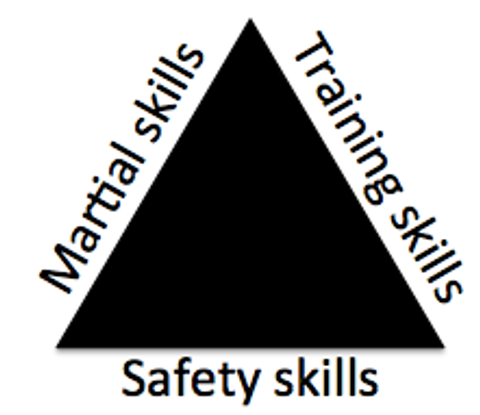
I took a workshop from Guru Mark Mikita where he described his methodology for training deadly martial techniques (Mark regularly trains police officers, marines, and body guards). His "Training Triangle" gives a clear picture:
1. Safety Skills
To train techniques with potentially high consequence you must first have a basis in how to train within your own and your partner's physical limits. The capacity to train slowly, keep control of your actions, to be relaxed and avoid sudden and unintended spikes in speed and intensity, is vital, especially when working with weapons. You want to be able to train in a way that you can do for hours, over days and weeks. This means taking out the "accidents" and reducing unnecessary stress on your body and mind.
2. Training Skills
As you build your ability to train safely you then build your ability to train effectively. Excellence in training is about rhythm, consistency, and presence. When you train to exhaustion or push past good sense in an effort to be "hardcore" your capacity to maintain presence in your training decreases steeply. At best this means you do poor quality practice, at worst it means you injure yourself or others. That definitely decreases progress and long-term well-being.
3. Martial Skills
Only with a basis in the skills of safety and training do you progress into the skills of war. There are only a select few partners that I would train with at a high level. I need to know that they have the ability and wisdom to manage their own safety and that they have the care and respect to manage mine. I want to stay on the path of excellence and reap its rewards for the next 50 years, not be knocked off it because of a careless injury.
The main challenge with "hardcore" is an attitude that speaks to ego, image, and machismo. These are destructive and fragile forces in martial arts and in life. Excellence is pursued thoughtfully, diligently, and with care. The risk and reward of every training environment needs to be carefully managed.
Yes, training for high intensity situations like tournaments or "real" fighting requires exposure to chaotic and challenging environments. You need to train how to really hit, how to manage scary and intense scenarios, or how to outfight a competitor. As you approach this training the risk increases, and that is all the more reason to make sure ego does not.