Fight or Flight, Part 2: Combative Calm
Devon Boorman ·

This post has been updated and re-posted from an earlier version.
Last week we looked at the Fight or Flight response and how it can negatively affect our training environment. This week we'll examine some useful tools to help alleviate stress during combat training and get us on the path to sound tactical responsiveness.
Cultivating Combative Calm
There are two sides to managing a high stress performance environment. One is conditioning your stress responses to be more useful. Through tactical training at scaling speeds you can work on conditioning your flinch response to be one that accomplishes your martial goals more reliably (i.e., puts your point on line or keeps your sword within a controlled area and doesn’t throw you out of position). The other is learning to enter into a state of mindfulness (fight) instead of flight. This is the state that will allow you to respond more intelligently to a given situation and not only avoid the flinch response but build and adapt your strategy to your opponent in real time.
With my student what we did to begin working in this more mindful place was slow down and reframe our practice objectives (with masks on). Instead of thinking of the purpose of our slow sparring to be victory, we thought of it as dancing. I invited her to participate in a fencing dance with me where sometimes I would be struck and sometimes she would be. Her main goal was to stay in rhythm with me, to move in sync with me. From this place she was able to relax her flight response and become engaged in a more creative and open fashion in our fencing. The quality of the fencing increased considerably and her awareness of what was happening along with it. In this calmer state she was more able to observe, respond creatively, and guide her physical reactions.
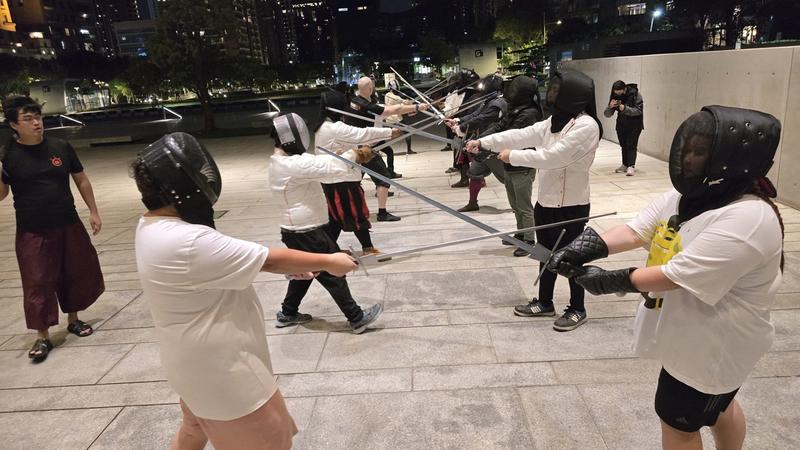
After we had established this baseline we began to increase the speed from 2 to 3 to 4. Through each transition I would return her attention to the mindful practice we had established before and we worked together to maintain the dancing quality of our interaction. Anytime things began to fall apart we brought the speed back down and re-centered.
Dance to Observation
In our next session we moved from the dancing paradigm to a martial one with an observational objective. The goal was still not to strike or avoid being struck but instead to ask questions (with our fencing) and see what the responses would be. Now as we fenced, beyond the questions I asked her with my sword, I verbally asked her
- What happened there?
- How would you solve this?
- Can you do that again and fix it?
- Can you make me do that again?
The control of our speed and the observational objective kept the flight response at bay and invited her to continue to open up her creative and strategic mind even as we increased the upper end of our allowable speeds.
This is a process that needs to be continued for a prolonged period to fully find results, but as in this case the immediate returns can be quite dramatic. Immediately you can find yourself across from a smarter and more competent partner, not because you have given them new competence but because you have created an environment that allows them to access the competence they already have.
The Training Continuum
I have found slow fencing and scaling speed fencing to be effective tools to help put combat into context and to bridge between drill and implementation, however they are not the only tools. As I commented on earlier in the article my student also needs to spend time at full speed to build her confidence simply by being in that environment. Drills, tactical exercises, focused fencing, and just good old conditioning are all part of building a solid and effective martial artist.
Every trainer and trainee needs to apply a full toolkit of strategies and approaches to be effective. I recommend if you do not include slow sparring as one of yours that you look at it seriously in all of its permutations and make it a regular part of how you build to full speed sparring.
Devon