Gioco Largo & Stretto: The Fencing Concepts You Need to Know
Devon Boorman ·
When you step into a fight, how do you decide what to do first? Do you press in aggressively, or do you stay at a safe distance and probe for openings? The answer isn’t just about personal style—it’s about reading your opponent, understanding their tendencies, and recognizing the space between you.
Wide and Narrow
One of the most important ways to assess a fight is by recognizing whether you’re in gioco largo (wide play) or gioco stretto (narrow play). These Italian fencing concepts help you determine not just distance, but the overall state of the fight—whether your opponent is open or closed, whether their weapon is threatening or withdrawn, and whether they fight with broad, flowing movements or tight, controlled actions.
By understanding gioco largo and gioco stretto, you can shape your strategy from the very first engagement. Do you keep the fight at a distance where cuts and evasions dominate, or do you step in to force tighter exchanges? Knowing how to recognize and transition between these modes of play is key to mastering both historical and modern fencing.
The Origins of Gioco
The Italian word for "play" is gioco, and is a concept that shows up in Italian fencing theory as early as the writings of Fiore dei Liberi (1409). Fiore uses this concept to mean both distance and proximity. This is generally predicated on whether the fencers are mirrored or matched in a crossing.
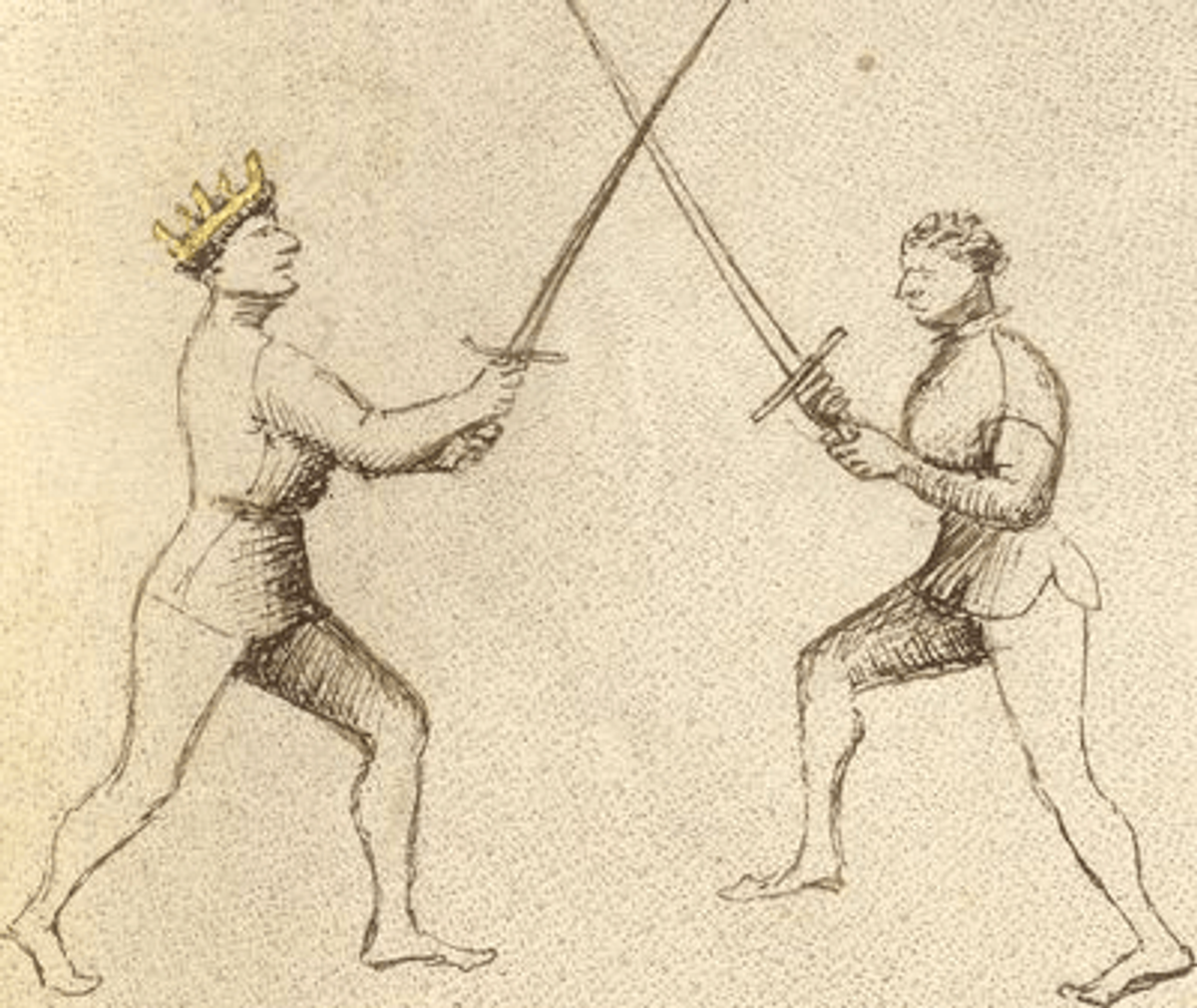
In the mirrored crossing, the master (crowned on the left) has their left leg forward and the opposite fencer has their right leg forward — Fiore places this crossing at the start of his section on gioco largo (wide play). The actions in this section typically include swordplay responses, such as cuts to the opposite side or turns against the sword to gain leverage. In the image below you can see a mirrored crossing.
In the matching crossing, the master (crowned on the left) has their right leg forward as does their opposite. Fiore gives this crossing at the start of the gioco stretto (narrow play) section. All stretto actions involve grappling. In the image below you can see a matching crossing.
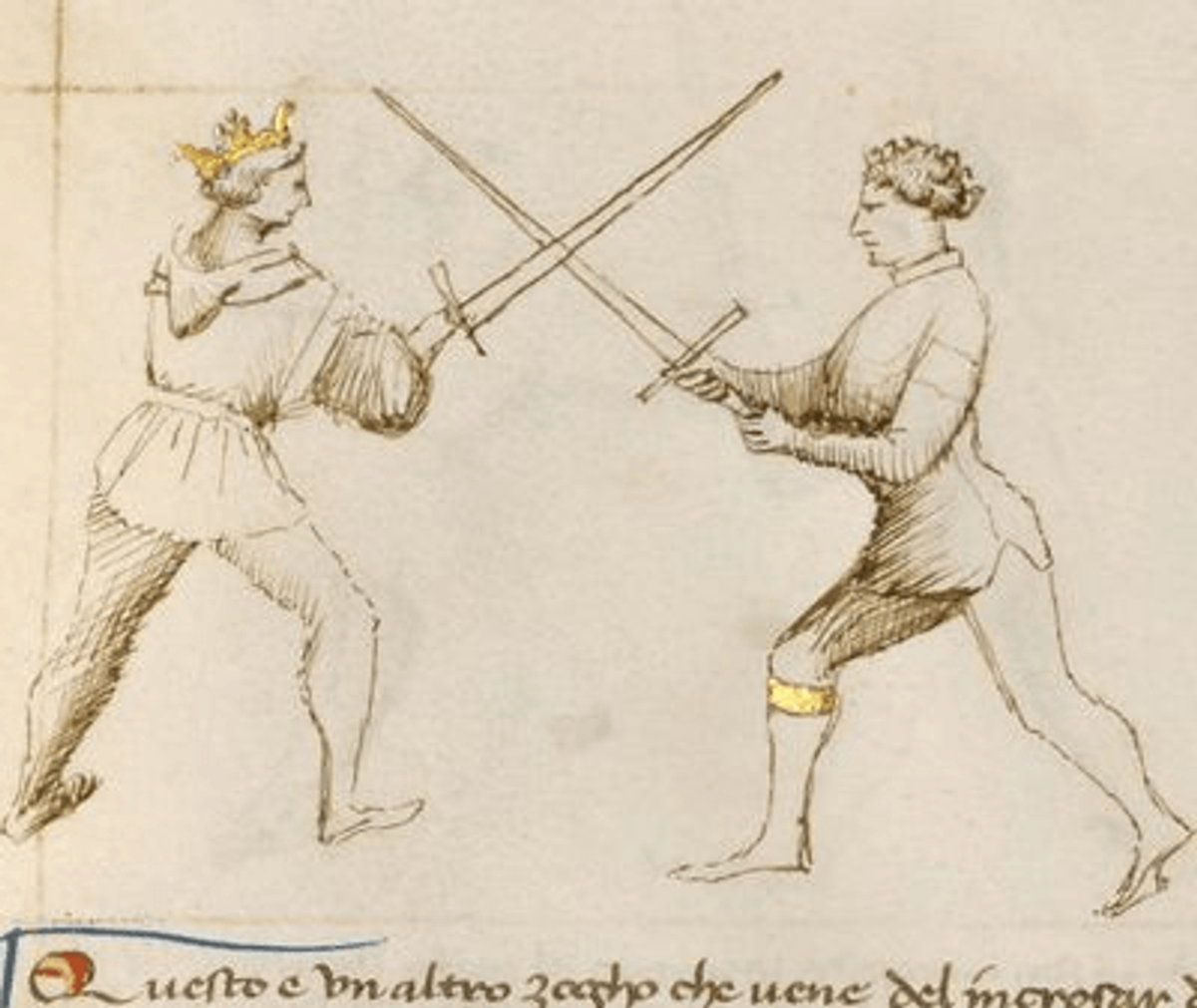
Tactically, when both fencers lead with their right sides, each person's lead hand is closer to the opponent, making grappling easier. Two hundred years later, English fencing instructor George Silver advised keeping the left leg forward in a parry to prevent grappling, showing a similarity in thought.
Evolution of Gioco
In the early Bolognese texts (1500–1600) the concepts of gioco largo and stretto have evolved to be more concerned with the relationship of the blades rather than the orientation of the bodies. That’s what we’re going to get into today with this video.
In Duello Armizare, we categorize our techniques similarly to the Bolognese masters—by the degree of threat and the closeness of the weapons. This way of looking at fighting is a useful tool for both understanding historical techniques but also for recognizing where you are tactically in a fight and what your priorities should be.
In this video, I break down three definitions of gioco—from foundational to strategic—to help you recognize where you are in a fight and what to do next.
If you want to take these concepts beyond theory and into practice, attending an Instructor Intensive is the perfect opportunity.
50-Hour Rapier & Longsword Instructor Intensive
Want to understand weapons martial arts on a deeper level? Have a desire to be able to coach both yourself and others more effectively? Looking for an opportunity to immerse yourself in over 50 hours of sword training?
Train intensively with me in Vancouver, immersing yourself in 50+ hours of dedicated rapier and longsword practice.